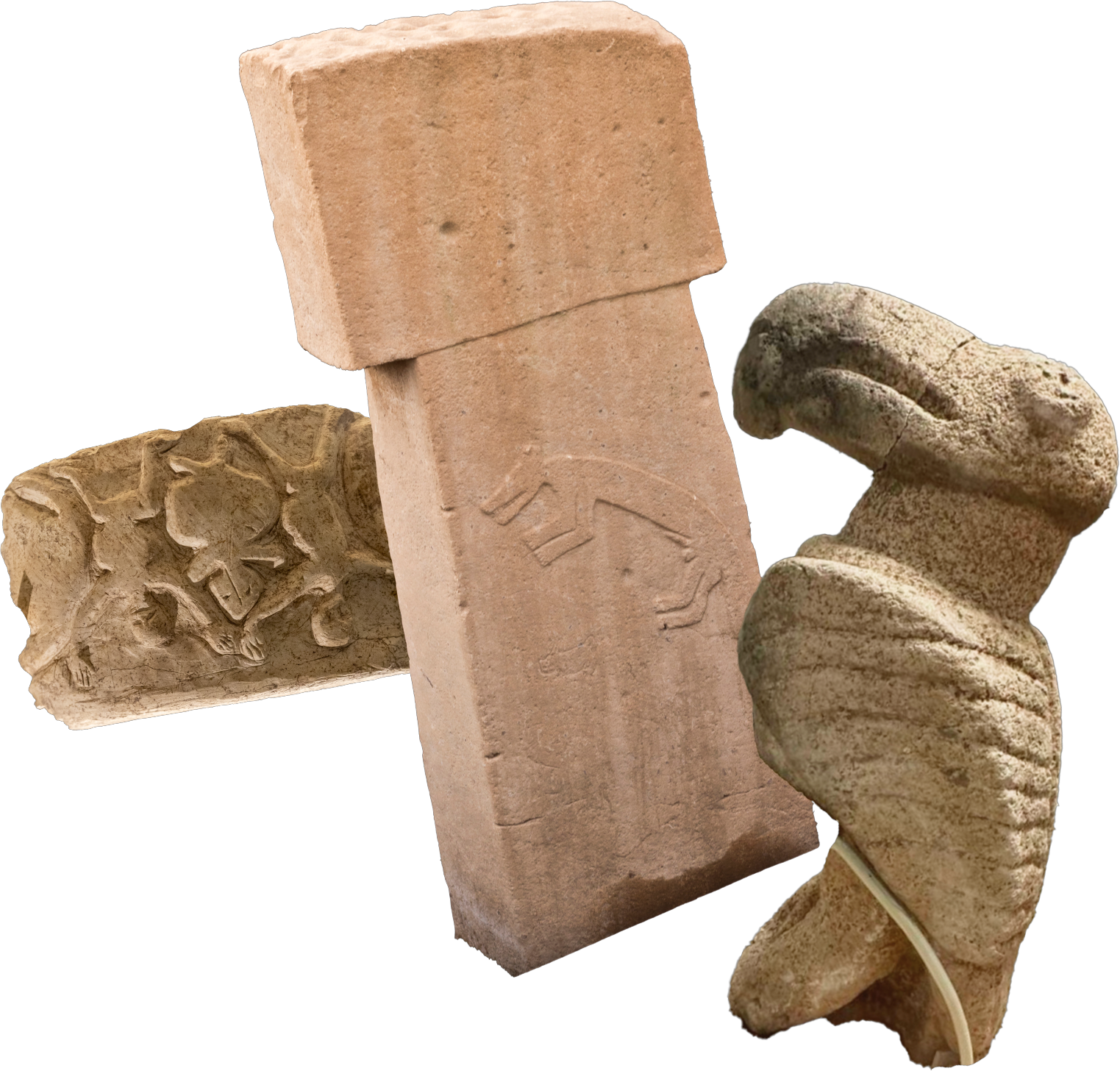
The 2025 excavation season at Karahantepe once again drew considerable attention with its remarkable findings. Closely followed by archaeologists and history enthusiasts, this season revealed discoveries that shed light on both the earliest phases of the settlement and its later architectural traditions. The material uncovered this year provides new insights into the social structure, ritual practices and architectural diversity of the Neolithic period. Karahantepe appears to have added yet another chapter to its long and complex history.
The BF Structure and the World's Earliest 3D Scene
Located directly beside Structure AD, the largest public building at Karahantepe, the BF Structure is a small-scale public unit excavated during the 2023 and 2024 seasons. Excavations revealed a chamber divided by T-shaped pillars set into the floor. Inside the chamber were stone vessels, stone plates and a variety of carved stone objects made primarily of black chlorite.
One vessel contained a carefully arranged group of figurines whose heads had been placed through small circular rings. The deliberate placement of these figurines suggests a staged composition — considered one of the earliest known three-dimensional scenes in human history.
Additional finds from BF include leopard, vulture and fox bones, large horns, burned cattle skulls and traces of hearths. The BF Structure appears to have formed part of the same public complex as Structures AD and AB, serving activities related to ritual preparation or food processing. The central posthole and inferred roof entry support this interpretation.
d7N4.jpg)
The BD Structure: A Monumental Rectangular Building on the Western Terrace
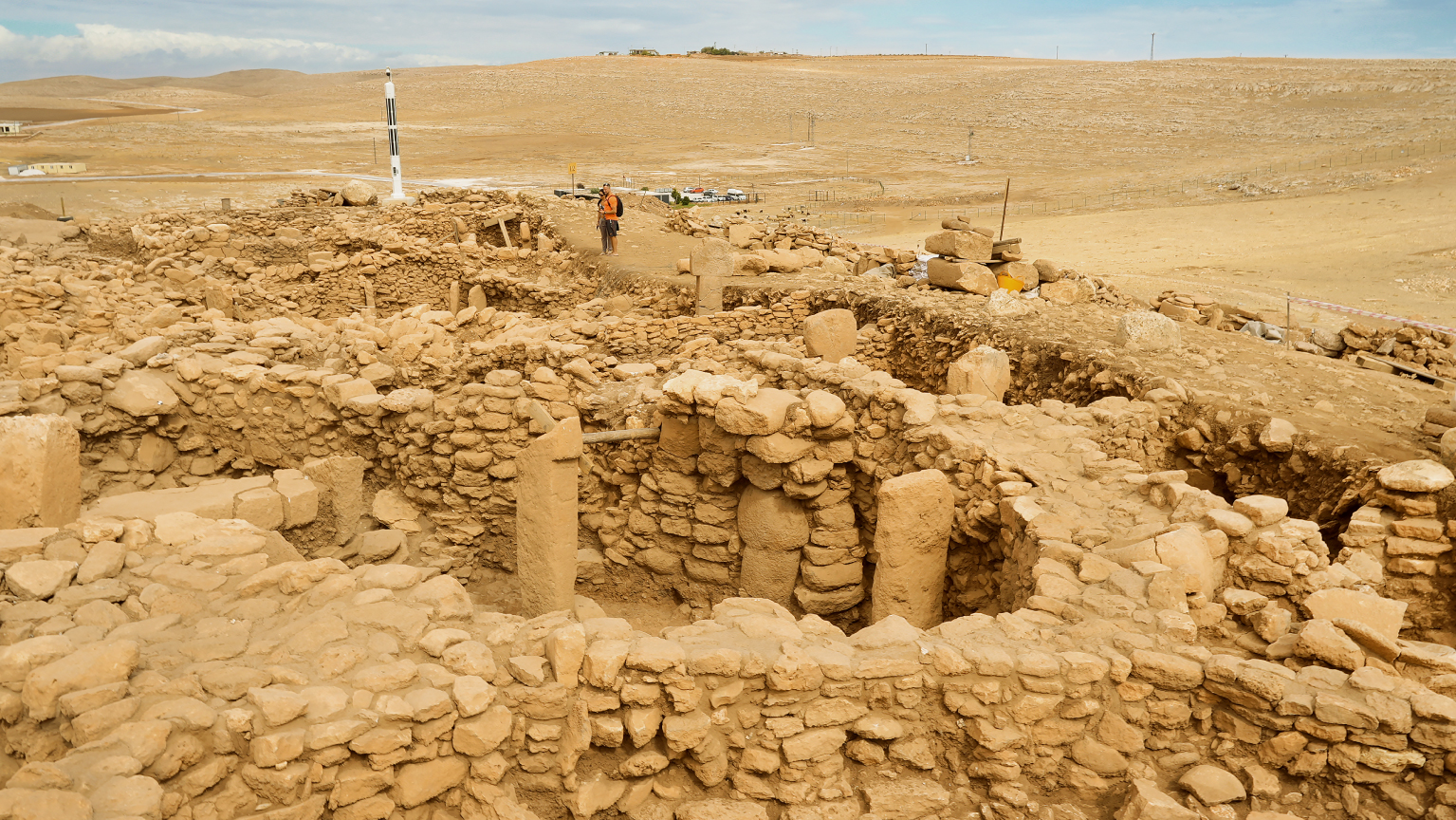
The Western Terrace at Karahantepe features several rectangular public buildings dating to the late phase of the settlement. Among them, the BD Structure stands out due to its scale and the significance of its finds. Its slightly rounded corners, symmetrically placed T-shaped pillars and continuous benches define its architectural layout.
In earlier seasons, a seated human sculpture and a griffon vulture sculpture were uncovered from this structure. During the 2025 season, another human sculpture was found — this one carved from basalt, a raw material identified here for the first time.
A total of 12 T-shaped pillars have been identified within BD. At the center lie four monumental T-shaped pillars that had collapsed in antiquity. Grinding stones and other everyday items discovered around the terrace suggest that hut-like domestic units once surrounded the BD Structure.
BePy.jpg)
The BH Structure: The Best-Preserved Rectilinear Plan of the Late Phase
Situated immediately beside BD, the BH Structure is one of the best-preserved rectilinear examples unearthed this season. Measuring 9 by 7 meters, its walls survive up to 3.5 meters in height. Traces of plaster and mudbrick at the wall bases indicate that the interior was originally plastered.
The interior layout is defined by two-tiered benches running along the walls. Four broken T-shaped pillars placed symmetrically within the structure further clarify the plan. Strong burning traces were identified on the floor, and damage to some benches suggests exposure to high temperatures.
Along the northern wall, excavators uncovered a large stone vessel, a two-step platform and a channel running beneath it. It appears that liquid poured into the vessel once flowed through this channel. A small elevated room was also identified in one corner of the structure; excavations inside this room will begin in the 2026 season.
wJR1.jpg)
The First Human-Faced T-Shaped Pillar
Located in the upper section of the Western Terrace, the AZ Structure is a late-phase domestic building. It features a stone-paved floor, plastered benches and grinding stones set directly into the ground. Of the four T-shaped pillars expected in the structure, three have survived.
During the 2025 excavation season, a human face motif was discovered carved on the front surface of one of these pillars. With sharply defined facial features and deep eye sockets, this carving represents the first direct evidence that T-shaped pillars symbolized the human figure.
7ara.jpg)
The AO Structure and the Stone Slab with a Running Wild Donkey Figure
The AO Structure, one of the small domestic units surrounding Structure AD, revealed a stone-paved floor and several stones associated with grinding activities, including a phallic-shaped grinding tool.
The most striking find from AO is a stone slab depicting a running wild donkey. Measuring approximately 20 centimeters in length, this figure is the first example of such a motif discovered embedded within a floor at Karahantepe. Since the wild donkey held both symbolic and subsistence value during the Neolithic period, this find adds a new dimension to the tradition of animal depictions within the Taş Tepeler region.
MUmG.jpg)
Explore Taş Tepeler with Stone Mounds
To follow new findings from Göbeklitepe, Karahantepe and the wider Taş Tepeler region including updated site information, 3D models, expert-led explanations and high-resolution visuals, download the Stone Mounds App.